Context
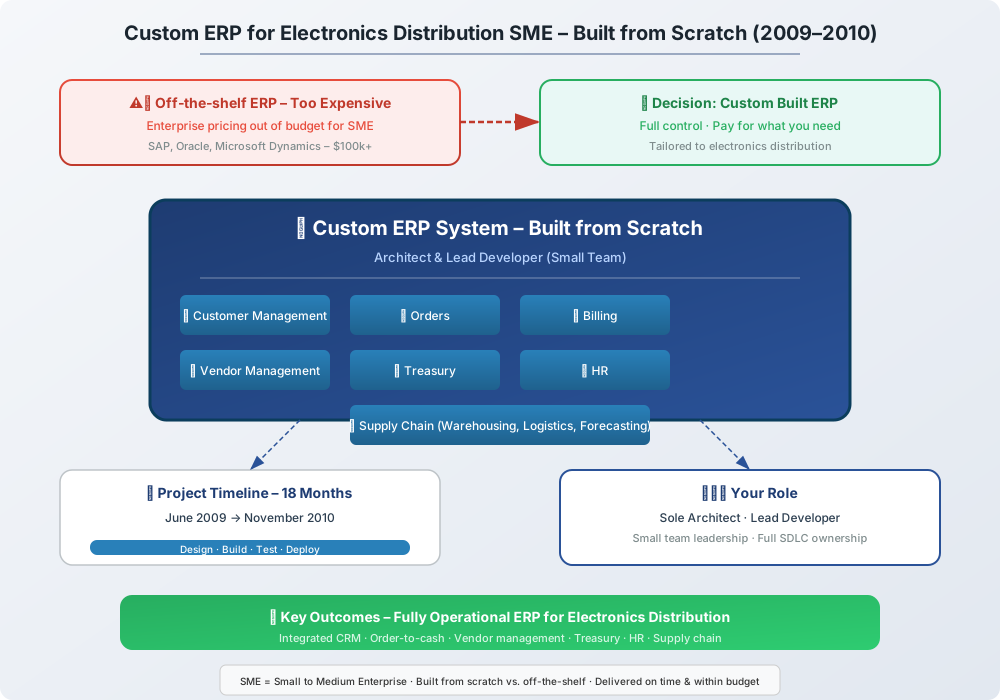
In mid-2009, Elahi Electronics — a growing SME in the electronics distribution space — needed a full Enterprise Resource Planning (ERP) system. Off-the-shelf ERP solutions were priced for enterprises, well beyond their budget. I was engaged to architect and build a custom ERP from the ground up, spanning customer management, orders, billing, vendor management, treasury, HR, and supply chain.
The project ran for 18 months, from June 2009 through November 2010, with a small team that I led as Architect and Lead Developer.
Goal
Build a complete, custom ERP for an SME — from authentication to business intelligence — using the Microsoft stack.
The ERP had to deliver:
- Role-based authentication and authorization via SharePoint Forms-Based Authentication (FBA)
- A rich client experience with Silverlight and WCF RIA Services
- Enterprise search with FAST Search for SharePoint (FS4SP), including multi-language support
- Business Intelligence with SQL Server Analysis Services (SSAS) cubes
- Integration with Dynamics CRM, Dynamics AX, and MQSeries via BizTalk 2009
- Smart Document tags that linked reports to live ERP data
Approach
-
Portal & Authentication
Built the ERP portal on SharePoint Server 2010. Implemented Forms-Based Authentication (FBA) with role-based access, ensuring that warehouse staff, sales, and finance each saw only their relevant modules. -
Rich Client with Silverlight
Developed the primary client interface in Silverlight 4, using WCF RIA Services for client-server communication. The Silverlight client supported real-time data grids, drag-and-drop order assembly, and interactive dashboards — far beyond what was possible with ASP.NET WebForms at the time. -
FAST Enterprise Search
Configured FAST Search for SharePoint (FS4SP) to index all ERP entities — customers, products, orders, invoices. Extended it with custom linguistics to translate product descriptions between English and regional languages. Integrated Smart Document Tags so that Word documents could pull live ERP data. -
Business Intelligence
Built SSAS cubes for sales analysis, inventory turnover, and financial forecasting. SSIS packages handled ETL from the operational database to the data warehouse nightly. -
Integration Fabric
BizTalk 2009 connected the ERP to Dynamics CRM (for sales), Dynamics AX (for finance), and MQSeries (for external partner communications).
Challenges
- Silverlight’s client-side processing model required careful data-loading strategies — eager loading caused UI freezes, lazy loading caused N+1 query problems.
- FAST Search linguistics customization was poorly documented; extending keyword stemming and thesaurus for non-English languages required trial and error.
- SSAS cube processing on the SME’s modest hardware required aggressive partition strategies to keep processing windows under 2 hours.
- The client’s business processes evolved during development — the architecture had to absorb change without constant rewrites.
Outcome
The ERP went into production serving 50+ concurrent users across sales, warehouse, finance, and management. The Silverlight client, while a technology that would later be deprecated by Microsoft, provided a genuinely modern experience in 2010. The FAST search integration reduced document retrieval time from minutes to sub-second queries.
Key takeaway
Building an ERP for an SME means building for evolution. Unlike enterprise ERP rollouts with fixed requirements, an SME’s processes change as they grow. Designing for extensibility — pluggable modules, metadata-driven forms, configurable workflows — was the difference between success and a permanent maintenance burden.