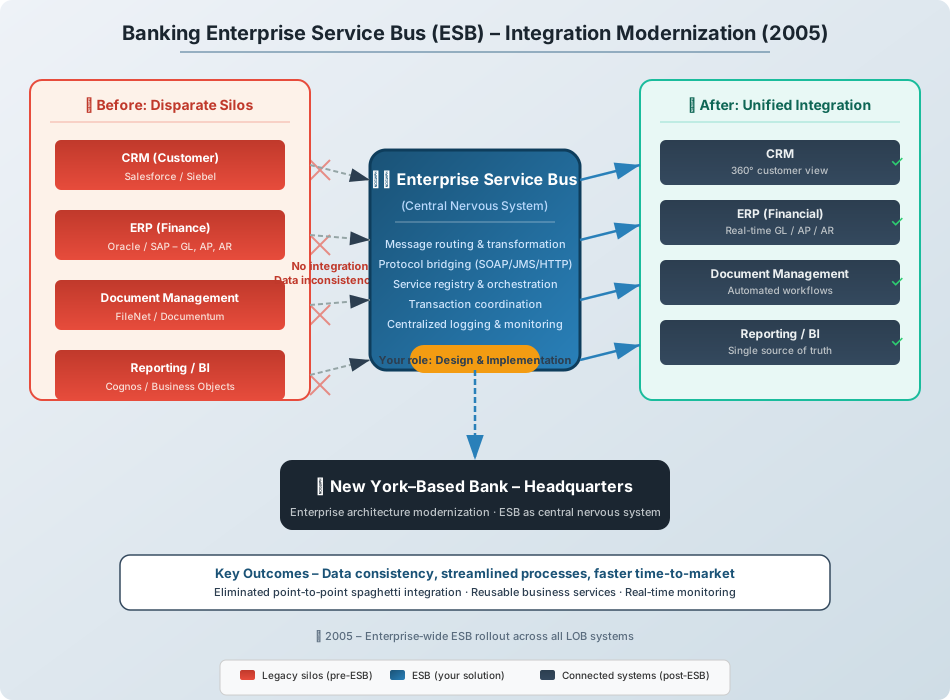
Context
In 2005, a major New York-based bank needed to modernize its integration architecture. Disparate line-of-business systems — CRM, ERP, document management, and reporting — operated in silos, creating data inconsistencies and slowing down business processes. I was brought in to design and implement an Enterprise Service Bus (ESB) that would serve as the central nervous system for all enterprise applications.
Goal
Build an Enterprise Service Bus that unifies Dynamics CRM, SQL Server, BizTalk, and SharePoint into a cohesive integration fabric.
The ESB needed to:
- Provide canonical message routing between all line-of-business systems
- Process EDI transactions through standardized pipelines
- Enable real-time OLAP reporting with ADOMD.Net
- Deliver intelligent document processing through SharePoint and Office 2007
- Expose business rules through a centralized rules engine
Approach
-
Canonical Message Model
Defined a common message schema that all systems would publish and subscribe to. BizTalk 2006 served as the broker, with custom pipelines for EDI, flat-file, and XML transformations. -
Business Rules Engine
Externalized business logic into the BizTalk Rules Engine (BRE), allowing non-technical analysts to modify rules — such as credit risk thresholds and compliance checks — without touching code. -
Intelligent Business Framework
Integrated SharePoint 2003/2007 with Office 2007’s Intelligent Business Framework (IBF), enabling contextual data lookups directly within Word, Excel, and Outlook. -
Real-Time Analytics
Built OLAP cubes with SQL Server 2005 Analysis Services and exposed them through ADOMD.Net, giving executives dashboards that refreshed on every EDI batch cycle.
Challenges
- The bank’s legacy EDI formats were poorly documented, requiring reverse-engineering of segment delimiters, loops, and qualifiers.
- BizTalk 2006 had memory-pressure issues under sustained EDI load — required careful host-throttling configuration.
- SharePoint 2003’s object model was notoriously leaky; custom web parts needed aggressive disposal patterns.
- Coordinating schema changes across 7+ line-of-business teams demanded rigorous governance.
Outcome
The ESB went live processing over 50,000 EDI transactions daily. OLAP dashboards reduced month-end close from 5 days to under 8 hours. The rules engine cut policy-change turnaround from weeks to hours.
Key takeaway
An ESB is only as good as its canonical model. Investing heavily in the message schema upfront paid dividends every time a new system joined the bus. Governance isn’t overhead — it’s the product.