Context
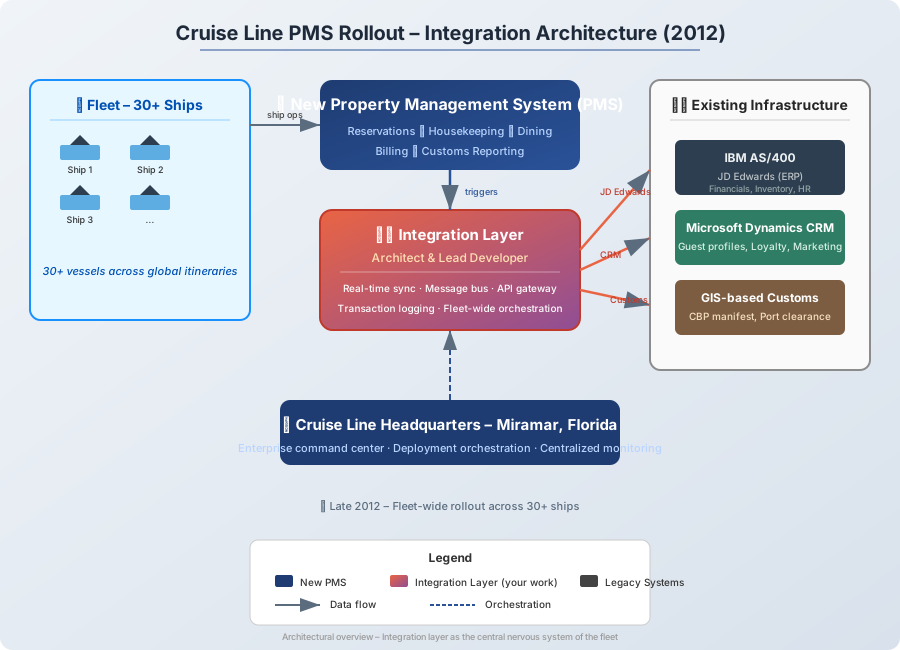
In late 2012, a major cruise line headquartered in Miramar, Florida, needed to roll out a new Property Management System (PMS) across its entire fleet — over 30 ships, each essentially a floating hotel with thousands of guests. The PMS replacement touched every onboard system: reservations, housekeeping, dining, billing, and customs reporting.
I served as the Architect and Lead Developer, responsible for the integration layer that would connect the new PMS to the fleet’s existing infrastructure — including JD Edwards on AS/400, Dynamics CRM, and GIS-based customs systems.
Goal
Replace the Property Management System across 30+ ships without disrupting onboard operations, while integrating customs reporting based on GIS data.
The integration had to:
- Synchronize PMS data with the corporate JD Edwards ERP running on IBM i (AS/400)
- Automate Dynamics CRM builds through TFS CI/CD
- Generate country-specific customs reports based on ship location (GIS)
- Support continuous deployment of approved builds using TFS Build Quality gates
- Handle intermittent connectivity — ships are offline while at sea
Approach
-
PMS Integration Hub
BizTalk 2009/2010 served as the central integration broker. I used the ESB 2.0/2.1 Toolkit to build an itinerary-driven message router: when a ship docked and connected, BizTalk processed the accumulated batch of PMS transactions, prioritizing customs reports for the destination country. -
AS/400 Host Integration
Wrote specifications for JD Edwards developers on the AS/400 side, then implemented the Host Integration layer using BizTalk’s MQSeries adapter. The AS/400 received nightly PMS syncs and returned inventory and financial data. -
GIS-Based Customs Engine
Ships crossing into a country’s territorial waters automatically triggered customs report generation. I integrated GIS data to determine jurisdiction and applied the correct customs forms (based on IMO FAL conventions) per country. -
TFS CI/CD for Dynamics CRM
Built a TFS plugin that promoted builds through quality gates — from Dev to QA to Production — automatically upon approval. This eliminated manual deployment errors and cut release cycles from days to minutes. -
Offline Resilience
Designed a store-and-forward pattern: PMS transactions queued locally on each ship during voyages and flushed to the integration hub upon connectivity, with conflict resolution for concurrent updates.
Challenges
- Maritime satellite internet is slow and expensive — batch sizes and compression had to be carefully tuned.
- Each country had its own customs form format, some requiring XML (e.g., UN/EDIFACT), others flat files.
- AS/400 integration required EBCDIC-to-ASCII conversion and fixed-width field parsing — a world apart from modern APIs.
- Coordinating PMS cutovers across 30 ships meant staggered rollouts over several months, with rollback plans per ship.
Outcome
The PMS was successfully deployed across the entire fleet. Customs reports that previously took hours to compile manually were now generated automatically upon port arrival. The TFS CI/CD pipeline became the standard for all future CRM deployments in the organization.
Key takeaway
Integration at sea is integration at the edge. Designing for disconnected operation, bandwidth constraints, and multi-jurisdictional compliance made this project a masterclass in resilient architecture.